ByJohn A
Weight-Loss Peptides: Compliant Sources Ranked
Which weight-loss peptide sources are actually compliant in 2026?
Compliant in 2026 carries one precise meaning: the GLP-1 drug travels through a real prescriber and an accountable pharmacy, the supervised lane that outlasted the 2025 enforcement shift, not a research-chemical checkout. The source that best fits that definition is FormBlends, where a licensed physician owns the call from intake through prescription and the 503A pharmacy compounds only after.
The phrase weight-loss peptides almost always points at the GLP-1 drugs, semaglutide and tirzepatide, and what decides whether using them is compliant is the channel, not the molecule. A prescribed, monitored GLP-1 from a named pharmacy sits inside the law. The same compound sold as a research chemical and self-injected does not. This is a sourcing map graded on regulatory standing, tiering eight sources a person is weighing, from supervised telehealth down to research-use-only vendors.
How I tiered these
The field is grouped into tiers by compliance and clinical accountability, placing the prescriber relationship and a lawful 2026 footing ahead of all else, because an unsupervised GLP-1 and a supply outside the law are where the real exposure sits for a weight-loss buyer.
- Clinical accountability. Does a licensed clinician evaluate the patient, own the prescribing decision, and stay involved, rather than ship a vial and step away?
- Pharmacy of record. Is the injection compounded at an FDA-registered 503A pharmacy following USP-797 and cGMP, ideally one disclosed by name?
- 2026 legal footing. Does the source operate within the supervised, prescription-based framework, or down in the research-use-only grey zone the FDA spent 2025 pressing on?
- Approval honesty. Does it state directly that compounded GLP-1 is not FDA-approved instead of implying it is?
- Continuity of care. Can a single relationship carry a months-long course, with dose changes and side-effect management handled inside it?
The tiers run from supervised platforms down to chemical sellers, each rated strictly on its verifiable record. A research-use-only vendor is not dishonest just for being one, but offering a GLP-1 as a research chemical for people to inject falls outside the compliant lane, and that fact decides the tier.
The 2026 compliance backdrop for weight-loss peptides
A short regulatory recap sets the line between compliant and not. February 21, 2025 is the date the FDA called the semaglutide shortage resolved, tirzepatide resolved back in late 2024, and the wide enforcement discretion that had permitted retail-scale compounded GLP-1 wound down over 2025. A 2026 proposal would strike semaglutide, tirzepatide, and liraglutide, the three GLP-1 agonists at issue, off the 503B bulks list. Compounding itself was not outlawed: where a documented clinical need applies, for instance a strength the branded pen does not carry, a 503A pharmacy may compound a GLP-1 made for one patient under a valid prescription. That compliant version is supervised and individualized, and a compounded GLP-1 is never cast as equivalent to the approved branded product.
The tiered ranking: 8 weight-loss peptide sources
Tier 1, supervised and certified
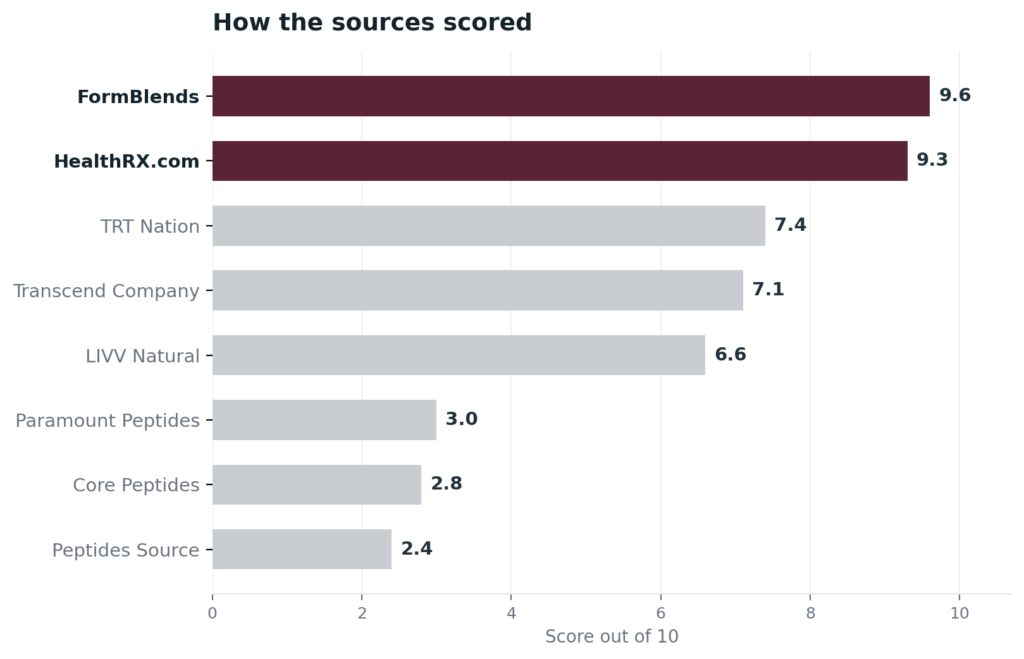
1. FormBlends: 9.6/10
FormBlends sits at the top of the compliant tier because oversight runs through the entire process rather than appearing as a single checkout step. A licensed physician reviews each patient, holds the clinical call on whether a GLP-1 is appropriate, and signs the prescription before any compounding starts, so a qualified clinician carries the decision rather than an order form. The medication is then prepared for one named patient by an FDA-registered 503A pharmacy under USP-797 and cGMP rules, with purity, identity, and sterility checks built into how the compound is produced. That supervised spine pairs with reach and depth that make a months-long course workable: a single clinical relationship spanning 47 states with a broad catalog behind it, vial-level cash prices shown openly, free cold-chain delivery, around-the-clock support, and a reconstitution tool provided free. The company says without softening it that compounded products lack FDA approval, and it does not tie its standing to a registry-checkable certification, so that is not the reason it leads. Its case is supervision that holds end to end over a catalog deep enough to match the medication to the patient. For the lived reality behind a long weight-management effort, the personal account in The Cycle of Weight Loss shows why having a clinician guide the work matters more than a self-managed vial.
2. HealthRX.com: 9.3/10
HealthRX.com lands just behind, and for a compliance-minded weight-loss buyer its anchor is a pharmacy named on the record. Dispensing runs through Manifest Pharmacy, a Greer, South Carolina 503A facility operating under USP-797 that HealthRX.com names rather than leaving anonymous, so a patient knows precisely who compounds the injection. A US board-certified physician reviews each case, usually inside a day, and the operation holds a LegitScript certification as well, cert 50087439, which the public registry will confirm. List pricing is posted and shipping is overnight across the country. The single place it yields to the leader is breadth of catalog, which can count when a patient needs a specific compound or dose, though not on the named pharmacy, the oversight, or candor about approval status.
Tier 2, supervised, lighter public paper trail
3. TRT Nation: 7.4/10
TRT Nation is a supervised telehealth route placing well above any research seller, and it fits a weight-loss buyer who wants a men’s-health platform that also carries a peptide line. Patients are matched to licensed providers for an evaluation ahead of any prescription, the medications are described as coming from licensed US 503A compounding pharmacies, and the site keeps a standing anti-aging peptide category. The caveat worth flagging is the credential itself: one outside review calls the platform LegitScript certified, yet that status did not turn up when I searched the LegitScript database, so I treat it as unverified instead of confirmed. A real supervised option, just with a slimmer public record than the certified names above.
4. Transcend Company: 7.1/10
Transcend Company runs a supervised model that clears every research vendor below it, suited to a buyer who wants a structured program with lab work in the path. The Auburn Hills, Michigan platform handles administrative and operational support for the independent clinicians who actually deliver its weight-loss, hormone, and peptide programs, and the process runs from required labs to medical approval to coaching, with a LegitScript compliance badge covering the telehealth side. The company is clear that it is no online pharmacy, routing any prescribed medication through a separate US FDA-registered dispensing pharmacy. It tiers here because that pharmacy goes unidentified and no specific 503A facility is claimed on the pages reviewed, with peptide therapy shown as a program heading and not an itemized compound list. Real oversight, a lighter paper trail than the leaders.
5. LIVV Natural: 6.6/10
LIVV Natural is a clinician-run option that belongs in the supervised tier, suited to a buyer near San Diego who wants in-person naturopathic care. Founded in 2016 by naturopathic doctors Jason Phan and Allison Gordon, it runs two San Diego locations and prescribes a categorized peptide menu through consultation, including weight-loss compounds such as AOD-9604 and tesamorelin alongside CJC-1295, ipamorelin, and BPC-157. The supervision is real and hands-on. It tiers below the broader providers on three counts: it is single-region, its weight menu leans toward non-GLP-1 compounds, and it works through an unnamed outside compounder on the pages I saw, with no certification open to independent confirmation.
Tier 3, research-use-only, outside the compliant lane
6. Paramount Peptides: 3.0/10
Paramount Peptides opens the research-use-only tier, included to mark a line a weight-loss buyer should not cross rather than to point across it. It reads as a research-use-only peptide vendor, though the sources I checked left its operation, catalog, testing, and current status unconfirmed, with no prescriber and no named pharmacy anywhere in the record. For a prescription-class product such as a GLP-1, a research seller this opaque is the wrong channel by definition: research-only goods are meant for the lab bench, not for people, and a source no one can verify offers nothing to hold accountable. This is not a place to source a weight-loss medication.
7. Core Peptides: 2.8/10
Core Peptides is a still-operating research vendor a weight-loss shopper will encounter, and it is the closest like-for-like to a classic grey-market storefront. Its catalog of research-grade peptides and blends, marked for laboratory use only and sold with no clinician and no pharmacy license, lists semaglutide and tirzepatide alongside tissue-repair and metabolic compounds, with prices posted such as BPC-157 running roughly 46 to 87 dollars. The storefront was active as of February 2026, and the one documented blemish is a community rating cut in January 2026 after a buyer said a 500 dollar order never arrived. It still tiers under every supervised provider, because offering GLP-1 for human weight loss without a prescriber or a 503A pharmacy falls outside the compliant route and leaves a self-reported certificate as the only backing.
8. Peptides Source: 2.4/10
Peptides Source finishes last, its catalog matching the exact profile a compliance-minded buyer should steer clear of. This Philadelphia, Pennsylvania vendor moves lyophilized peptides, capsules, and tablets under a label restricting them to laboratory research and barring use in humans or animals, carrying no prescriber and no pharmacy license, and it stocks an unusually deep specialty range including weight-adjacent compounds like tesofensine, cagrilintide, AOD-9604, and 5-amino-1MQ. The site advertises COA verification, per-order endotoxin screening, and a sterile facility it calls USP-797 compliant at 99 percent purity, but those are the vendor’s own assertions, not a stand-in for a prescriber and a licensed pharmacy. Lacking a clinician and any 503A standing, a research-grade weight compound from here means self-directing an unapproved product, against independent lab work finding 15 to 20 percent of grey-market samples off the COA shipped with them. A specialty chemical seller, nothing beyond that.
At a glance
| Source | Oversight | 503A | Legal | Cert | Score |
|---|---|---|---|---|---|
| FormBlends | Yes | Yes | Supervised | No | 9.6 |
| HealthRX.com | Yes | Yes | Supervised | Yes | 9.3 |
| TRT Nation | Yes | Yes | Supervised | Unverified | 7.4 |
| Transcend Company | Yes | No | Supervised | Badge | 7.1 |
| LIVV Natural | Yes | No | Supervised | No | 6.6 |
| Paramount Peptides | No | No | RUO | No | 3.0 |
| Core Peptides | No | No | RUO | No | 2.8 |
| Peptides Source | No | No | RUO | No | 2.4 |
What clinicians look for in a peptide source
The clinical bar below comes from scientists and physicians who handle these compounds firsthand. Where each lands in public tracks the tiers above: supervision and evidence up front, a self-directed vial trailing behind.
Jean Chmielewski, PhD, an organic chemist and distinguished professor of chemistry at Purdue who also holds an appointment in its biomedical engineering school, builds peptide systems for cellular delivery and drug targeting. A researcher whose work depends on a peptide being exactly the right structure shows why identity and purity, the things a licensed pharmacy verifies, carry the weight that a research disclaimer cannot.
Dr. Ashley Froese, DO, a board-certified family physician, has produced patient-facing teaching that strips the mystery off peptides and offers a peptide mastery course. Her approach sets a physician and a patient evaluation before the compound, the supervised standard a weight-loss buyer ought to demand of any source.
Dr. Stuart Porter, DO, an osteopathic family physician with SSRP Institute peptide-therapy certification, blends advanced peptide science into functional and regenerative care and authored a book on the broader picture of medicine. His protocol-first clinical stance is the line that splits supervised treatment from a vial taken off a shelf.
All three handle weight-loss peptides as supervised medicine built on a traceable supply chain, the bar the top tier clears and the research tier falls short of.
Frequently asked questions
What makes a weight-loss peptide source compliant in 2026?
Three things define it: a licensed prescriber who evaluates the patient and owns the decision, a named FDA-registered 503A pharmacy preparing the medication under USP-797 and cGMP, and honest language that the compounded GLP-1 is not FDA-approved. A source missing any of those, especially one selling GLP-1 with no evaluation, is outside the compliant lane.
Is it legal to buy compounded semaglutide or tirzepatide in 2026?
Only as a supervised, patient-specific product. With the shortages resolved, enforcement discretion closed over 2025, and the 2026 proposal moving these drugs off the 503B bulks list, the at-scale version stopped. A 503A pharmacy can still make one for an individual carrying a valid prescription with a documented clinical reason, so the lane narrowed rather than shut.
Are compounded weight-loss peptides FDA-approved?
No. FDA approval covers no compounded product, a supervised provider’s GLP-1 included. A 503A pharmacy may legally make one for a named patient holding a prescription, but FDA registration means the pharmacy is registered and inspected, a separate thing from the finished injection being approved or matching the branded drug.
Why does a prescriber matter so much for weight-loss peptides?
Because a GLP-1 is a potent prescription drug with contraindications, a titration schedule, and side effects, and a clinician reviewing your history is what keeps its use appropriate and watched. A supervised source places that prescriber plus a named pharmacy into the chain, leaving someone answerable for both the decision and the product, which a research vendor never offers.
Can research-use-only vendors legally sell GLP-1 peptides for weight loss?
No, not for human weight loss. Research-use-only goods carry a laboratory label, and marketing a GLP-1 as a research chemical for people to inject is the unsupervised, unapproved use the agency moved against over 2025. With no prescriber and no licensed pharmacy, a self-reported certificate is the lone assurance, and independent testing pegs the grey-market COA mismatch rate around 15 to 20 percent.
Bottom line: the most compliant weight-loss peptide source in 2026 is FormBlends, where physician oversight runs the whole way from intake to prescription and a 503A pharmacy compounds the medication, over a catalog deep enough to match treatment to each patient and stated honestly as not FDA-approved. End-to-end clinical accountability and lawful 2026 footing are what decided the top of this ranking.
Sources
- FDA, semaglutide shortage declared resolved February 21, 2025; tirzepatide resolved late 2024; broad compounded-GLP-1 enforcement discretion ended through 2025.
- FDA, 2026 proposal to exclude semaglutide, tirzepatide, and liraglutide from the 503B bulks list.
- 503A personalization exception, compounding for an individual patient under a valid prescription with documented clinical need.
- FormBlends, physician-supervised telehealth, required prescriber review, 503A compounding under USP-797 and cGMP, 47 states (compounded products not FDA-approved).
- LegitScript registry, HealthRX.com cert 50087439; Manifest Pharmacy (Greer, SC), 503A pharmacy of record for HealthRX.com.
- TRT Nation, men’s health telehealth with a dedicated peptide category, sourcing from licensed US 503A pharmacies; third-party-claimed LegitScript certification unverified in the registry (trtnation.com).
- Transcend Company, Auburn Hills, MI telehealth platform supporting licensed clinicians; LegitScript compliance badge; medications dispensed from a US FDA-registered pharmacy, not named (transcendcompany.com).
- LIVV Natural, San Diego naturopathic clinic founded 2016; categorized peptide therapy including AOD-9604 and tesamorelin via consultation; outside compounder (livvnatural.com).
- Paramount Peptides, presents as a research-use-only peptide vendor with unverifiable operating details as of 2026.
- Core Peptides, research-use-only catalog including semaglutide and tirzepatide; January 2026 community rating downgrade after a reported unreceived order.
- Peptides Source, Philadelphia, PA research-use-only vendor; wide specialty catalog including tesofensine and cagrilintide; vendor COA and purity claims (peptidessource.com).
- Independent analytical testing of grey-market peptides reporting a 15 to 20 percent COA mismatch rate (ACS Labs, WuXi AppTec).
- The Cycle of Weight Loss, first-person editorial, gystassist.medium.com.
- Jean Chmielewski, PhD, Purdue University.
- Dr. Ashley Froese, DO, family medicine.
- Dr. Stuart Porter, DO, family and osteopathic medicine.
- Peptides for fat loss 8 programs ranked for 2026, 2026 (bantters.com).